
An ice dam is a ridge of ice that accumulates at or near the eave edge of a sloped roof. On residential buildings across Canada — from southern Ontario to northern Alberta — ice dams are a recurring winter problem, but they do not form randomly. Each one is the end result of a specific thermal sequence that begins inside the building.
The Three-Stage Sequence
Understanding ice dam formation requires following heat as it moves from the living space upward through the ceiling assembly and into the attic. The sequence unfolds in three stages that typically play out over several days during a sustained cold period.
Stage 1: Heat Accumulation in the Attic
In a well-functioning cold-climate roof assembly, the attic space should remain close to the outdoor temperature throughout winter. When insulation is insufficient, discontinuous, or bypassed by air leakage, heat from the conditioned space below enters the attic and raises the temperature of the roof deck above freezing — even when outdoor temperatures are well below 0°C.
The most significant contributors to attic heat accumulation in Canadian residential construction are ceiling air leaks — gaps at partition wall top plates, around pot light housings, at attic hatch frames, and through plumbing and electrical penetrations. These pathways move warm, humid air directly into the attic, bypassing the insulation layer entirely.
Building Science Note
Air Leakage vs. Conduction
Heat loss through air leakage can significantly exceed conductive heat loss through the insulation layer in poorly sealed ceiling assemblies. Adding more insulation without addressing air sealing provides limited improvement in ice dam prevention.
Stage 2: Snowmelt on the Upper Roof
Once the roof deck temperature rises above 0°C, the snow layer directly in contact with the deck begins to melt from the bottom up. The surface of the snowpack may remain cold and show no visible sign of melting. Meltwater forms at the deck surface and begins flowing downslope underneath the snowpack.
The volume of meltwater produced depends on the area of roof where the deck is warmed, the temperature of the deck surface, and the duration of the warming period. On a typical Canadian residential roof with a 6:12 slope, several centimetres of snow accumulation can produce a meaningful flow of meltwater within 24 to 48 hours of attic overheating beginning.
Stage 3: Refreezing at the Eave
The eave overhang extends beyond the exterior wall of the building. Unlike the roof area over the attic, the eave overhang has no warm attic space below it — it is exposed to outdoor air on its underside. When meltwater reaches this zone, it encounters a surface that is at or below freezing. It refreezes and begins to accumulate.
Over successive warming and cooling cycles, the ice ridge grows both in height and in extent upslope. Water backed up behind the ridge has nowhere to drain and begins pooling under the shingles — a condition that can allow water infiltration into the roof deck, insulation, and ceiling assembly.
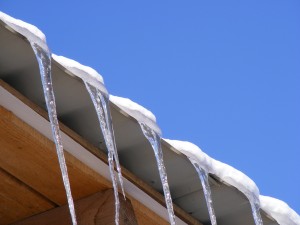
Ice accumulation at a residential roof eave — visible ice ridge with icicle formation. Photo: Emilian Robert Vicol / Wikimedia Commons (CC BY 2.0)
Why Canadian Roof Geometry Matters
The risk of ice dam formation is not uniform across all roof types. Several geometric factors specific to Canadian residential construction influence how readily ice dams develop.
Eave Overhang Length
Longer eave overhangs increase the distance between the heated attic zone and the exposed eave edge. This can mean meltwater travels further before reaching the freezing zone, giving it more opportunity to penetrate the roof assembly if flashing is inadequate. Canadian residential design frequently uses 300–600mm eave overhangs for aesthetic and water-management reasons, which creates a consistent location for ice dam formation.
Roof Slope
Very low-slope roofs (below 2:12) rarely develop classic ice dams because meltwater does not flow with enough velocity to travel far. Very steep roofs (above 10:12) tend to shed snow before it accumulates in sufficient depth to generate significant meltwater. The mid-range slopes common in Canadian residential construction — 4:12 to 7:12 — are where ice dam conditions develop most consistently.
Snow Retention
Textured or rough roofing surfaces, north-facing slopes, and roof configurations with dormers or valleys that trap snow all increase the probability of sustained snow accumulation. In much of Canada, the combination of periodic thaws and sustained cold snaps — particularly in regions like southern Quebec, the Ottawa Valley, and southern Manitoba — creates repeated freeze-thaw cycles that drive ice dam growth over the course of a single winter.
Regional Variation in Canada
Ice dam risk is not evenly distributed across Canada. The most problematic conditions arise where winter temperatures fluctuate repeatedly across the freezing point, accumulating snow does not shed, and older housing stock with limited attic insulation predominates.
Regions with the highest reported ice dam incidence in Canada include southern Ontario (particularly areas north of the Great Lakes), the Ottawa-Gatineau corridor, southern Quebec, New Brunswick, and Nova Scotia — all of which combine cold winters with significant snowfall and periodic mid-winter thaws.
In contrast, the Prairie provinces experience sustained cold with less frequent thaw cycles, which tends to produce a different failure pattern: snow accumulates but does not melt repeatedly, reducing the frequency of active ice dam formation. However, when warming does occur, the volume of meltwater can be substantial.
Identifying an Active Ice Dam
An ice dam that has developed to the point of causing water infiltration will often show some of the following signs:
- A visible ice ridge at the eave, typically 50–200mm or more in height
- Icicles hanging from the eave or gutters
- Damp spots, staining, or peeling paint on interior ceilings near exterior walls
- Wet insulation in the attic space above the exterior wall
- Water staining on the underside of the roof deck near the eave
Interior water damage from ice dams is frequently misdiagnosed as a roofing defect or a flashing failure. While inadequate flashing can exacerbate the problem, the root cause is almost always the thermal condition in the attic — specifically, a roof deck that is too warm relative to the outdoor temperature.
Interaction with Ice and Water Shield
Canadian building codes and good practice require the installation of a self-adhering bituminous membrane — commonly known by brand names that have become generic in the trade — under the shingles at the eave. The National Building Code of Canada requires this membrane to extend from the eave edge to a point at least 900mm inside the interior face of the exterior wall.
This membrane provides a secondary barrier against water infiltration when ice dam conditions cause water to back up under shingles. It does not prevent ice dam formation — that requires addressing the thermal conditions in the attic — but it limits the damage that a moderate ice dam can cause.